


Pharmacological Basis, Clinical Applications, and Practical Considerations for Drinking-Water Administration
The Economic Impact of Bacterial Diseases in Poultry
Bacterial infections continue to impose significant economic losses throughout the poultry value chain. Among the most important bacterial disease syndromes encountered in broiler production are:
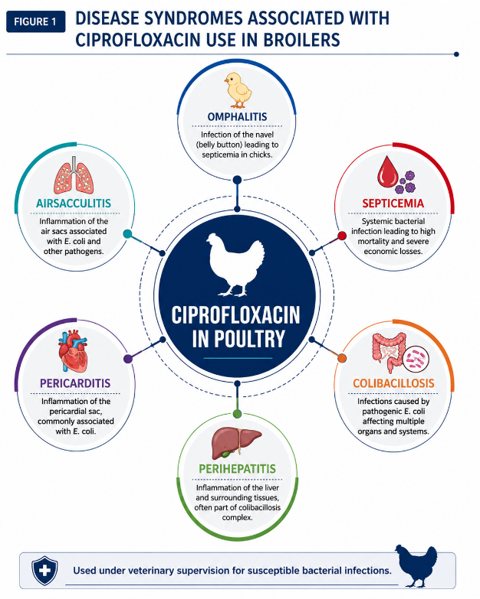
Escherichia coli remains one of the most frequently isolated bacterial pathogens associated with these conditions. The first week of life is particularly critical, as early chick mortality associated with bacterial infections can have long-term consequences on flock performance.
Disease Syndromes Associated with Ciprofloxacin Use in Broilers.
Why Rapid Intervention Matters
The progression of bacterial infections in poultry can be remarkably rapid.
What begins as localized bacterial colonization may quickly develop into respiratory involvement, systemic septicemia, polyserositis, and ultimately mortality. As disease progresses, treatment becomes increasingly difficult and production losses become more severe.
The success of antimicrobial therapy often depends not only on antimicrobial selection but also on the speed with which effective treatment is initiated.

Ciprofloxacin as a Solution:
The ideal antimicrobial for modern poultry production should possess:
• Rapid bactericidal activity • Broad-spectrum efficacy against susceptible bacterial pathogens
• Excellent tissue penetration • Systemic distribution • Practical administration characteristics
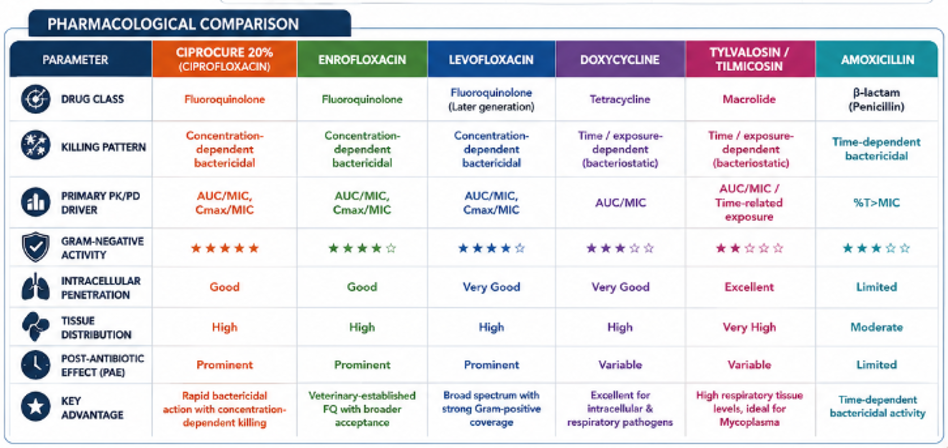
Ciprofloxacin possesses many of these attributes. As a second-generation fluoroquinolone, ciprofloxacin exerts its antibacterial activity through inhibition of bacterial DNA gyrase and topoisomerase IV, resulting in concentration-dependent bacterial killing.
Unlike bacteriostatic agents that inhibit bacterial growth, ciprofloxacin rapidly reduces bacterial populations when adequate tissue concentrations are achieved.
Pharmacokinetic studies have demonstrated favorable oral absorption, broad tissue distribution, and effective systemic exposure following administration in broiler chickens.
These characteristics make ciprofloxacin particularly suitable for bacterial infections involving respiratory tissues, serosal surfaces, and internal organs.
Clinical Applications in Broiler Production
Although ciprofloxacin is often associated with colibacillosis, its clinical utility extends beyond a single disease condition.
Its use may be considered in susceptible bacterial infections associated with:
• Colibacillosis • Colisepticemia • Omphalitis • Yolk sac infections • Airsacculitis
• Pericarditis • Perihepatitis • Secondary bacterial respiratory infections
• Septicemic disease complexes
The broad tissue distribution achieved following oral administration allows ciprofloxacin to reach multiple target sites commonly affected during systemic bacterial infections.
Why Route of Administration Influences Treatment Success
“In modern broiler production, therapeutic success depends not only on antimicrobial efficacy but also on the speed, uniformity, and reliability of drug delivery.”
Experimental Evidence Supporting Clinical Use of Ciprofloxacin: Several studies have demonstrated the effectiveness of ciprofloxacin in controlling susceptible bacterial infections.
In an experimental E. coli challenge model, ciprofloxacin-treated broilers demonstrated significantly lower mortality, reduced bacterial recovery, improved clinical recovery, and superior production performance compared with untreated challenged birds.
Mortality Reduction in Experimental E. coli Challenge.
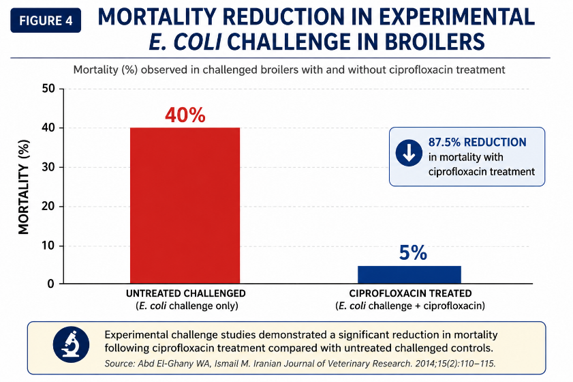
These findings reinforce the importance of rapid intervention and effective antimicrobial therapy during bacterial disease outbreaks.
Conclusion
Modern poultry production requires both effective antimicrobial therapy and efficient delivery systems to successfully manage bacterial disease challenges.
Ciprofloxacin combines concentration-dependent bactericidal activity, favorable pharmacokinetic characteristics, broad tissue distribution, and suitability for drinking-water administration, making it an important therapeutic option in the management of susceptible bacterial infections in broilers.
When combined with rapid diagnosis, appropriate administration, and responsible antimicrobial stewardship, ciprofloxacin continues to play a valuable role in contemporary poultry health management.
Furthermore, oral liquid formulations can enhance the practicality of water medication programs through improved ease of handling, rapid dispersion, and greater operational convenience under commercial production conditions.